Primary market: Germany. This guide covers the refreshed regular IONIQ 6 sold in Germany during the 2026 model cycle. The regular 2026 model is not offered in the United States; Hyundai’s announced U.S. continuation is the separate IONIQ 6 N. Remaining U.S. 2025 stock should not be confused with a 2026 model.
The 2026 Hyundai IONIQ 6 is an electric sedan for buyers who want to travel efficiently without moving into an SUV. Its appeal rests on the combination of an aerodynamic body, a larger battery option and rapid charging. Its suitability still depends on everyday questions: can you charge conveniently, do your passengers fit comfortably, and can your usual luggage pass through the boot opening?
This is a researched buyer’s guide, not a personal road test. German specifications, euro prices and WLTP ratings are used throughout. The facelift is documented in Hyundai’s March 2026 German press kit and ADAC’s January-2026-onward model listing; registration in 2026 alone does not identify the facelift.
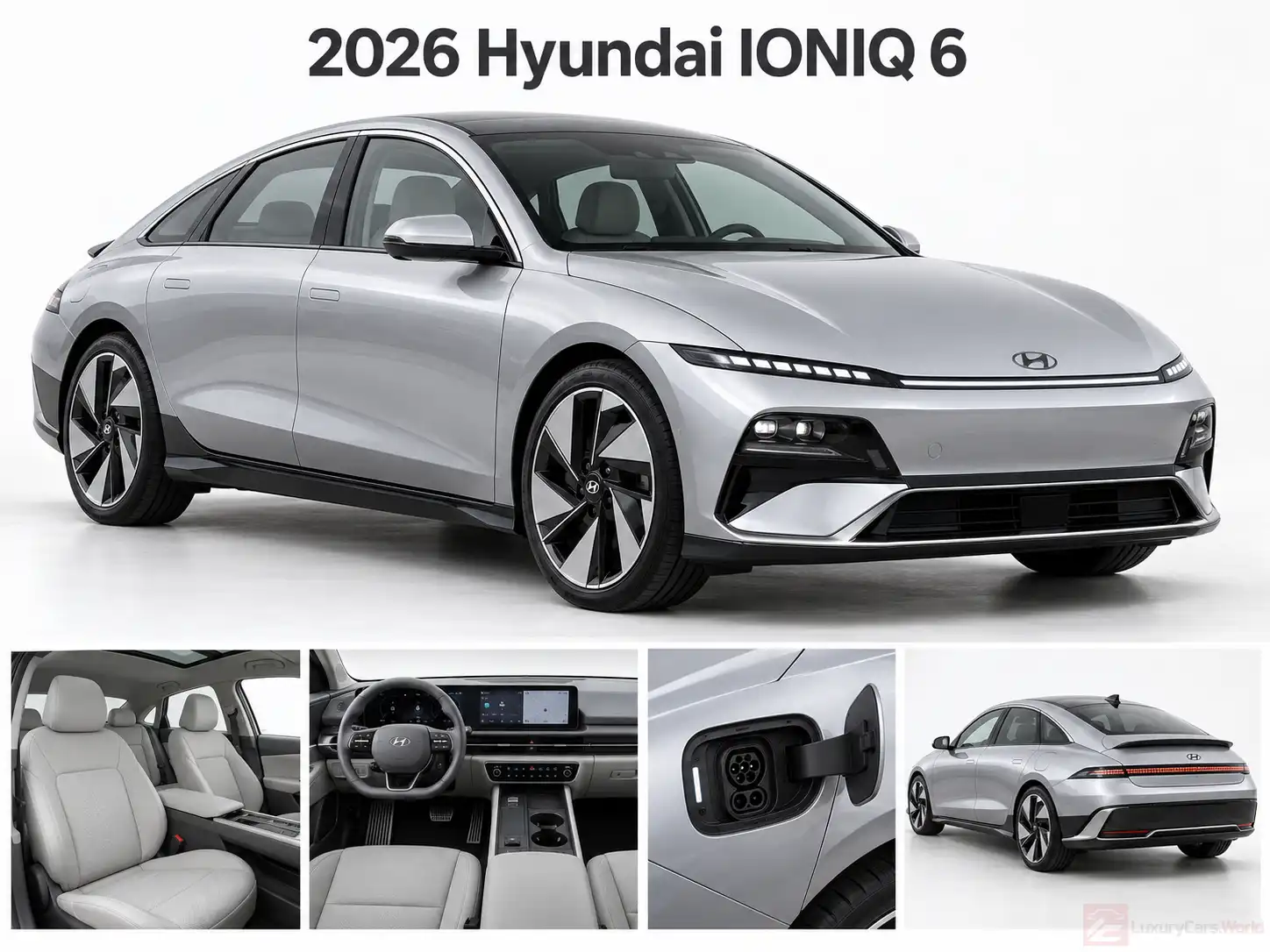
2026 Hyundai IONIQ 6
The IONIQ 6 deserves a place on the shortlist of commuters and frequent long-distance drivers who prefer a sedan. Choose the battery around your journeys, then choose equipment around needs you will notice every week.
The strongest buying argument is charging and efficiency rather than maximum acceleration. The biggest reservations concern passenger headroom, luggage access and the cost of moving into higher specifications. A family should bring its child seats and pushchair to the showroom; a motorway commuter should test the route planner and charging workflow.
The value-oriented starting point is the 63-kWh rear-drive model. Frequent long-distance buyers should compare the 84-kWh rear-drive configuration before paying extra for all-wheel drive or sporty styling.
2026 Hyundai IONIQ 6 Specifications
| Item | German-market specification |
|---|---|
| Vehicle category | Battery-electric, four-door sedan |
| Generation | Facelift of the first-generation IONIQ 6 |
| Seating | Five |
| Battery choices | 63 kWh or 84 kWh, manufacturer-stated capacity |
| Drivetrain choices | Rear-wheel drive; 84-kWh all-wheel drive also available |
| Transmission | Single-speed reduction gearing |
| Entry configuration | 63 kWh, RWD, 125 kW/170 PS, 350 Nm |
| Long-range RWD | 84 kWh, 168 kW/229 PS, 350 Nm |
| Long-range AWD | 84 kWh, 239 kW/325 PS, 605 Nm |
| Maximum combined WLTP range | 680 km: 84-kWh RWD, 18-inch wheels |
| Entry starting advertised price | €45,750, excluding delivery charges |
Powertrain figures come from Hyundai’s German facelift specifications. The maximum-range configuration is identified on Hyundai Germany’s model page, and pricing is checked against the German trim page.
PS means metric horsepower, which differs slightly from U.S. mechanical horsepower. The battery figures above should not be assumed to represent usable energy. The maximum range does not apply to every trim or wheel combination.
What Changed for 2026?
This is a facelift rather than an entirely new generation. The updated car retains the E-GMP electric platform while introducing revised front and rear styling and larger battery choices. The previous upper rear spoiler disappears, producing a less layered rear appearance.
The refresh replaces the earlier 53- and 77.4-kWh battery options with 63 and 84 kWh. Interior changes include revised physical controls, USB-C connections and the newer ccNC infotainment architecture.
For buyers, the important distinction is between the updated car and discounted pre-facelift stock. Ask for the battery specification, equipment list and production/model identification in writing. A newer registration plate does not settle that question.
2026 Hyundai IONIQ 6 Price and Trim Levels
The following are Hyundai Germany’s advertised starting recommended prices checked on 9 October 2026, rather than guaranteed dealer transaction prices. Obtain a VAT-inclusive written quotation identifying delivery, registration, options and additional fees separately.
| Current page heading | Battery at advertised starting price | Advertised starting price |
|---|---|---|
| Select | 63 kWh | €45,750 |
| Trend | 63 kWh | €52,250 |
| N Line | 84 kWh | €58,300 |
| Prime | 84 kWh | €60,500 |
| N Line Evo | 84 kWh | €62,000 |
Delivery charges are additional; options and dealer prices can differ.
Trim-label caution: Hyundai’s page headings use Select, Trend, Prime and N Line Evo, while parts of the same page and its press material retain base, CENTRIQ, UNIQ and N Line X labels. Some range and drivetrain footnotes also conflict. Treat the table as advertised starting prices rather than a complete ordering matrix. Confirm the current trim code, battery, wheels and drivetrain before signing.
Which Version Makes the Most Sense?
Choose the entry RWD car if your routine is predictable and you can recharge at home or work. Buying more battery than you regularly need ties up money that could fund a wallbox, insurance or occasional public charging.
For frequent motorway travel, the 84-kWh RWD version is the configuration to investigate first. It prioritizes distance between stops without adding a second motor. ADAC identifies the 84-kWh CENTRIQ RWD at €55,600, but because Hyundai’s current labels differ, verify the equivalent orderable version and price with a dealer.
Higher equipment can be worthwhile when it solves a regular inconvenience. Surround-view cameras matter to someone using a narrow garage. A heat pump is worth discussing for cold-weather use; do not assume it is included in every version.
2026 Hyundai IONIQ 6 Exterior Design and Dimensions
| Measurement | Refreshed regular IONIQ 6 |
|---|---|
| Length | 4,925 mm |
| Width | 1,880 mm |
| Height | 1,495 mm |
| Wheelbase | 2,950 mm |
The width figure is not a mirror-to-mirror parking clearance.
The low, curved roofline gives the car a distinctive silhouette, but styling cannot tell you whether it fits your garage. Measure the parking space with doors opening and mirrors accounted for. Leave room to reach the charging connection without stretching a cable across a walkway.
Visibility deserves its own test. Reverse into a realistic parking space, check the rear-quarter view and try the cameras on the actual trim being considered. If optional camera mirrors appeal, compare them with conventional mirrors in daylight and after dark before committing.
2026 Hyundai IONIQ 6 Interior, Seating and Comfort
A five-seat designation should be treated as capacity rather than a guarantee that five adults will enjoy a long journey. Test rear headroom with your tallest passenger, then check how the front seat position affects those behind.
The same applies to accessibility. Sit down and stand up several times, wearing normal outdoor clothing. Buyers accustomed to a tall SUV should check whether the lower seating position is comfortable for their knees and back.
Materials and convenience equipment vary. Check the order sheet for seat heating, ventilation, memory adjustment and upholstery rather than assuming that photographs show standard equipment. The showroom car may have options that change both price and cabin feel.
ADAC’s facelift test specifically identified restricted rear headroom and uneven body panel gaps. Those findings make a close inspection worthwhile, but they do not establish that every car has identical build quality.
2026 Hyundai IONIQ 6 Cargo Space and Everyday Practicality
Hyundai’s German press material lists a 401-litre rear luggage compartment. Front storage is 45 litres for RWD versions and 14.5 litres for AWD. These are separate compartments, not one continuous loading area.
A capacity figure cannot describe the boot opening, height under the lid or the shape around wheel housings. Try actual suitcases and a pushchair. Folding the rear seats helps with longer loads but does not turn a sedan into an estate.
Store charging cables where they remain accessible when holiday luggage is loaded. If you carry sports equipment or travel with a dog, assess the loading arrangement directly. Cargo figures from different manufacturers should not be ranked unless their measurement methods and included compartments match.
Electric Powertrain and Performance of 2026 Hyundai IONIQ 6
| Configuration | Manufacturer 0–100 km/h claim |
|---|---|
| 63-kWh RWD | 8.3 seconds |
| 84-kWh RWD | 7.4 seconds |
| 84-kWh AWD | 5.1 seconds |
These are manufacturer claims rather than this article’s test results.
The sensible question is whether the RWD version provides the response you need for joining fast traffic and overtaking safely. Test it with passengers if the car will regularly travel loaded. The faster AWD version may appeal to enthusiastic drivers, but additional acceleration alone does not establish better value.
All-wheel drive also does not replace suitable winter tyres. Buyers facing snowy conditions should budget for the correct tyres before treating another driven axle as the answer.
N Line and IONIQ 6 N are different products. Do not attribute the N performance model’s output or track hardware to an ordinary N Line car.
Driving Behavior: What Independent Testing Found
ADAC’s test of the refreshed 84-kWh CENTRIQ RWD described a relatively firm suspension and criticized braking performance, reporting a stopping distance of almost 38 metres from 100 km/h. It also found the extending door handles inconvenient.
These findings suggest a useful test-drive route: broken urban surfaces, a faster road, parking manoeuvres and several ordinary braking events. Evaluate steering effort, visibility and brake feel yourself. Do not attempt emergency-braking measurements on public roads.
Wheel and tyre differences can affect your impression. Drive the version you plan to purchase rather than relying entirely on an unusually well-equipped demonstrator.
Electric Range and Charging
WLTP Range Versus Independent Results
The 63-kWh RWD model is advertised at up to 521 km WLTP. The maximum 680-km figure belongs to the 84-kWh RWD car on 18-inch wheels.
ADAC reported 532 km in its test of the 84-kWh rear-drive car and electricity consumption of 17.0 kWh/100 km including charging losses. Those results belong to its test procedure; they are neither an EPA rating nor a guarantee for your route.
For trip planning, leave a reserve and use consumption appropriate to the weather and speed. A full-battery laboratory rating does not equal the distance between motorway charging stops, especially when you choose to arrive above empty and depart below full.
Fast Charging
Hyundai claims approximately 18 minutes for 10–80% charging at a suitable 350-kW DC station. That is the station rating, not a claim that the vehicle continuously accepts 350 kW. Battery temperature and charging conditions matter.
ADAC lists up to 260-kW DC capability and 11-kW AC charging for the tested 84-kWh RWD model.
Peak power is one moment on a charging curve. For travel, time spent across a useful charge window matters more. Precondition the battery using the vehicle’s instructions, check station availability and keep a backup location in mind.
Home Charging
Before ordering, obtain an installation quotation and confirm the available electrical supply. An 11-kW onboard charger does not make every household connection capable of supplying 11 kW.
For routine commuting, overnight replenishment can make the smaller battery convenient. If your only option is public charging, compare tariffs, walking distance and charger reliability before deciding an EV fits your schedule.
Technology and Infotainment
The car has separate 12.3-inch instrument and infotainment displays. Smartphone integration supports Apple CarPlay and Android Auto. Hyundai warns that Bluelink and over-the-air services may involve paid subscriptions.
Pair your own phone during the demonstration and verify the connection method on the actual vehicle. Try entering a destination, finding charging stops and adjusting common controls. Ask which connected features remain available after any included service period ends.
Safety and Driver Assistance
Hyundai’s entry specification includes automatic emergency braking, adaptive cruise control and highway assistance. More advanced assistance and parking equipment depend on trim. These systems assist a supervising driver; they do not make the car autonomous.
Euro NCAP’s accessible IONIQ 6 assessment is dated 2022. Its validity history does not document a 2026 facelift confirmation in the material checked. Consequently, this guide does not label the refreshed car as having a newly verified 2026 five-star result.
Buyers should test assistance controls and warning behavior, but keep crash-test evidence separate from an equipment checklist.
Reliability, Recalls and Warranty
The facelift does not yet have sufficient long-term history to justify declaring it reliably trouble-free. A warranty reduces some financial exposure; it does not measure failure frequency.
Recall status as of 9 October 2026: a definitive official German recall result for the exact facelift could not be retrieved during this research. This is not evidence of zero recalls. The official KBA recall database should be checked, and Hyundai should confirm outstanding campaigns against the individual VIN before delivery.
German warranty terms include five-year vehicle coverage without a general mileage limit and high-voltage battery coverage for eight years or 160,000 km, whichever comes first. Component exceptions and special-use conditions apply; review the warranty booklet rather than importing U.S. warranty terms.
Ownership and Running Costs
Electricity cost depends as much on where you charge as on vehicle efficiency. Use your tariff and expected annual distance when comparing ownership plans.
Illustrative example—not a forecast: assume 15,000 km annually, metered electricity use of 18 kWh/100 km and electricity at €0.35/kWh.
Annual electricity cost would be:
15,000 ÷ 100 × 18 × €0.35 = €945
At an assumed €0.65/kWh, the same energy use costs €1,755 annually. These tariffs and consumption are assumptions rather than verified owner bills.
The example excludes wallbox installation, insurance, tyres, servicing, financing and depreciation. Obtain insurance quotations for the exact version and compare finance totals rather than monthly payments alone.
An EV still needs scheduled attention. Follow Hyundai’s local maintenance requirements and budget for tyres and consumables. For depreciation, compare a realistic purchase offer, lease terms and used-car alternatives; no defensible future resale percentage can be promised here.
2026 Hyundai IONIQ 6 Pros and Cons
Reasons to Consider It
- The larger-battery RWD configuration offers a useful balance for long journeys.
- Fast charging can shorten properly planned travel stops.
- Buyers can select battery capacity separately from the decision to pursue maximum performance.
- German warranty coverage provides a defined ownership safeguard.
Reasons to Inspect Carefully
- Rear headroom may be unsuitable for taller regular passengers.
- A sedan boot opening can limit bulky luggage despite the stated capacity.
- ADAC’s firm-ride and braking observations warrant an appropriate test drive.
- Conflicting online trim labels make a detailed written order specification essential.
Competitor Comparison
The comparison below uses rear-drive alternatives available in Germany, keeping performance flagships out of an efficiency-focused shortlist. These are current market specifications, not a claim that all brands use identical model-year conventions.
| Vehicle/configuration | Advertised combined WLTP range | Buyer priority |
|---|---|---|
| IONIQ 6 84-kWh RWD, 18-inch wheels | Up to 680 km | Rapid charging and efficient sedan travel |
| Tesla Model 3 Premium Long Range RWD, 18-inch wheels | Up to 750 km | Maximum advertised distance between charges |
| BYD SEAL Design RWD, 82.5-kWh battery | Up to 570 km | Compare sedan equipment and purchase value |
| Polestar 2 Long Range Single Motor | Up to 659 km | A rear-drive fastback alternative |
Polestar lists 220 kW and a 6.2-second 0–100 km/h claim for this single-motor version, with 10–80% charging quoted at 28 minutes. Those figures provide a useful performance and charging reference, but they are not a simultaneous test against the Hyundai.
Do not rank these cars solely by WLTP distance. Compare route planning, the controls you prefer, seat comfort and equivalent dealer quotations. For the BYD, ensure the quotation concerns the updated 2026 vehicle: its official announcement identifies an enlarged 485-litre rear luggage compartment. Do not reuse the older model’s luggage figure.
Who Should Buy It—and Who Should Consider Alternatives?
Consider the IONIQ 6 if you have dependable charging, prefer a low sedan and place more importance on travel efficiency than carrying tall loads. The 63-kWh RWD version deserves attention for predictable commuting; the larger-battery RWD deserves attention for frequent journeys beyond your local area.
Consider alternatives if rear headroom is a daily concern, loading a large pushchair is awkward or easy access from a higher seat matters most. A fastback may solve luggage access; an SUV or estate may suit bulky family equipment better.
For public-charging-only buyers, make the decision after testing a normal week’s charging arrangements. A compelling specification sheet cannot compensate for a charger that is inconvenient or routinely unavailable.
Frequently Asked Questions About 2026 Hyundai IONIQ 6
Is the Regular 2026 Hyundai IONIQ 6 Sold in the United States?
No. The regular 2026 model is not offered there; the announced continuation is the separate IONIQ 6 N. U.S. 2025 stock is a different model year.
Is the 2026 IONIQ 6 a New Generation?
It is the refreshed first-generation model. Check the battery and specification rather than using registration year as proof.
Is It Electric or Hybrid?
It is battery-electric. The configurations covered here have no petrol engine or hybrid fuel tank.
Which Version Has the Longest Advertised Range?
The 84-kWh RWD configuration with 18-inch wheels carries the maximum 680-km WLTP claim. Confirm the rating on your chosen build.
Does It Charge at 350 kW?
The 350-kW figure describes the station used for Hyundai’s charging-time claim, not sustained vehicle charging power.
Is N Line the Same as IONIQ 6 N?
No. Verify the exact model designation; an N Line badge does not establish N-model performance hardware.
What Is the Starting Price in Germany?
The current advertised entry price is €45,750 before delivery charges. The dealer’s written total may differ.
Is the Smaller Battery Enough for Commuting?
It can be a sensible choice with convenient charging. Calculate your winter journey requirements and reserve rather than relying on the maximum rating.
Has the Facelift Received a Verified 2026 Crash-Test Rating?
A facelift-specific confirmation was not established from the Euro NCAP record checked. The available assessment is dated 2022.
Can This Guide Confirm That a Particular Car Has No Recalls?
No. That requires an up-to-date VIN check and confirmation that applicable work has been completed.
Final Verdict About 2026 Hyundai IONIQ 6
The 2026 Hyundai IONIQ 6 is most persuasive as an efficient sedan selected around actual travel needs. Begin with the smaller-battery RWD car for routine use, then consider the 84-kWh RWD when longer journeys justify its cost.
Before buying, settle three questions in person: passenger fit, luggage access and charging convenience. The remaining research uncertainties—trim-label inconsistencies, facelift crash-rating applicability and VIN-specific recalls—should be resolved with current documents rather than assumptions. With those checks completed, the IONIQ 6 can be judged on the journeys it needs to make, not simply its longest advertised range.
Sources
- Hyundai Germany IONIQ 6: refreshed styling, maximum range and charging qualifications.
- German variants and prices: current advertised prices, equipment and warranty footnotes.
- German facelift press information: powertrains, luggage capacity and technology.
- European technical data: body dimensions.
- ADAC facelift model record and test PDF: independent results and observations.
- Euro NCAP assessment: assessment date and validity history.
- KBA database directory: official recall-check resource; no definitive result obtained.
- Edmunds U.S. availability report: manufacturer-attributed market decision.
- Tesla Germany, BYD Germany and Polestar Germany: competitor configurations.