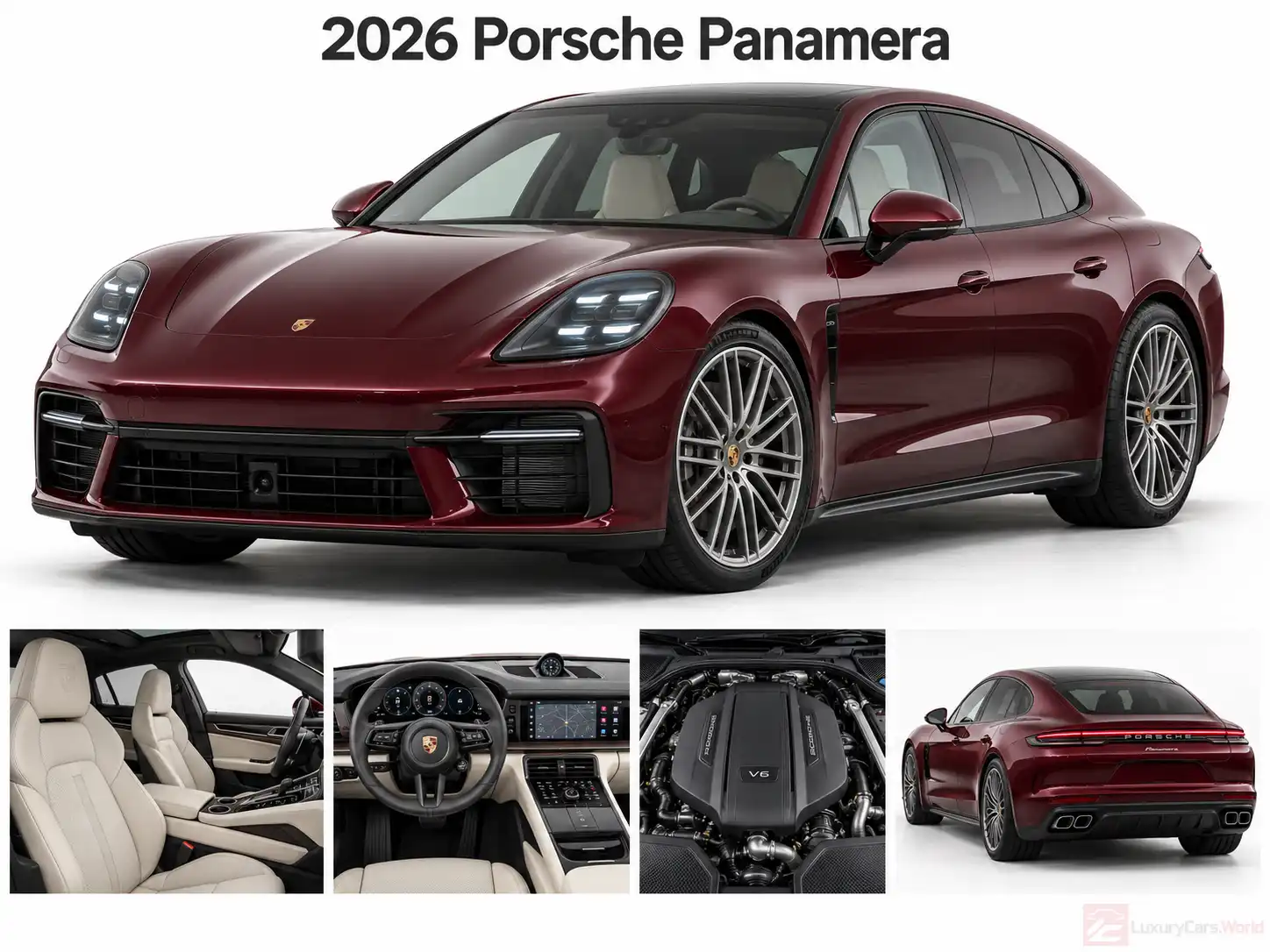
The 2026 Porsche Panamera is a luxury performance car for buyers who want engaging driving dynamics without giving up rear seats and useful luggage space. Its sedan-like profile conceals a practical rear hatch, while its seven-model U.S. lineup offers everything from a rear-wheel-drive V6 to a powerful V8 plug-in hybrid.
The central buying decision is how you intend to use it. The standard Panamera provides the lowest entry price. The Panamera 4 adds all-wheel drive. E-Hybrid versions offer rechargeable electric capability, while the GTS targets buyers who specifically want a gasoline V8 and a more sporting specification.
At the top, the Turbo S E-Hybrid produces 771 horsepower, but the less powerful models deserve serious attention. More expensive does not automatically mean better suited to commuting, family journeys or everyday roads.
This researched guide covers the United States market throughout. Prices and specifications come primarily from Porsche’s document explicitly labeled MY26, rather than its current model pages, which now display 2027 vehicles.
Porsche Panamera
The Panamera makes its strongest case to an owner who enjoys driving and needs more passenger and luggage flexibility than a two-door sports car provides.
Its strengths include a useful hatchback layout, a broad powertrain selection and chassis technology designed to balance body control with comfort. Its drawbacks include expensive options, substantial width and a driving position that requires more effort to enter than a typical SUV.
Our value recommendation is the Panamera 4. Consider the 4 E-Hybrid if you can charge regularly. The GTS suits buyers who want its V8 character and firmer sporting emphasis; the Turbo models serve more specialized performance priorities.
2026 Porsche Panamera Specifications
| Item | 2026 U.S.-market specification |
|---|---|
| Vehicle category | Luxury performance fastback with rear hatch |
| Generation | Third generation |
| Seating | Four standard; optional additional rear seating position |
| Gasoline models | Panamera, Panamera 4 and GTS |
| Plug-in hybrids | 4 E-Hybrid, 4S E-Hybrid, Turbo E-Hybrid and Turbo S E-Hybrid |
| Engines | 2.9-liter twin-turbo V6 or 4.0-liter twin-turbo V8 |
| Transmission | Eight-speed Porsche Doppelkupplung, or PDK |
| Drivetrain | RWD on the base model; AWD on the others |
| Output range | 348–771 hp |
| E-Hybrid battery | 25.9 kWh gross capacity |
| Base-model EPA economy | 18 city/25 highway/21 combined mpg |
| Starting base MSRP | $113,000, before delivery and other charges |
| Primary market | United States |
The lineup is verified by Porsche’s MY26 technical sheet. Seating information comes from year-specific equipment coverage; battery and economy figures are separately sourced.
What Changed for 2026?
The 2026 Panamera continues the third generation introduced for the 2024 model year. Its principal confirmed updates concern digital functions rather than a complete redesign.
Porsche’s U.S. announcement identifies:
- Faster Porsche Communication Management hardware.
- Access to the Porsche App Center.
- Integration of Amazon Alexa.
- Dolby Atmos capability with Bose and Burmester audio systems.
- Porsche Connect included for ten years.
Dolby Atmos requires compatible equipment and an appropriate audio source; it should not be assumed to work with every recording or the basic audio system.
MotorTrend’s 2026 coverage additionally reports standard Surround View with Active Parking Support and noise-insulating glass for the Turbo E-Hybrid models. Confirm these features on the particular U.S. build before purchase.
2026 Porsche Panamera Prices and Trim Levels
Porsche’s MY26 U.S. technical document gives the following base MSRPs. The delivered reference totals add $2,350, consistent with published 2026 pricing.
| Model | Official base MSRP | Reference MSRP including delivery |
|---|---|---|
| Panamera | $113,000 | $115,350 |
| Panamera 4 | $120,400 | $122,750 |
| Panamera 4 E-Hybrid | $127,200 | $129,550 |
| Panamera 4S E-Hybrid | $139,100 | $141,450 |
| Panamera GTS | $166,900 | $169,250 |
| Panamera Turbo E-Hybrid | $207,900 | $210,250 |
| Panamera Turbo S E-Hybrid | $245,200 | $247,550 |
Prices were checked on October 9, 2026. They exclude optional equipment, taxes, registration and dealer charges. The base figures are manufacturer-published; the delivery-inclusive totals are corroborated by year-specific pricing references.
These are MSRPs, not guaranteed selling prices. Some online pages retain earlier figures, making the individual window sticker particularly important.
Which Panamera Offers the Best Value?
The Panamera 4 is the most straightforward recommendation. It provides AWD without requiring charging or the substantial price jump to a V8.
The 4 E-Hybrid costs $6,800 more before options. That premium buys a different powertrain and stronger combined output, but its practical value depends on charging access.
The 4S E-Hybrid adds performance while retaining the V6-based hybrid layout. Buyers should compare it with a similarly equipped 4 E-Hybrid rather than judging the difference solely by horsepower.
The GTS is an enthusiast choice. Select it because you want the V8 and its sporting setup, after testing its ride on your normal roads.
Options Deserve Their Own Budget
Seats, upholstery, lighting, driver assistance and chassis equipment can materially change both the price and the experience.
Set an equipment budget before configuring the car. Prioritize seating, visibility and functions you use regularly, then consider appearance upgrades.
A lightly optioned higher model and a heavily optioned lower model can serve very different needs despite similar final prices.
2026 Porsche Panamera Exterior Design and Dimensions
The Panamera’s long hood, low roof and rising rear window line give it a more sporting profile than a traditional upright luxury sedan.
For the standard Panamera, Porsche’s MY26 sheet lists:
| Measurement | Dimension |
|---|---|
| Length | 198.8 inches |
| Wheelbase | 116.1 inches |
| Width, mirrors folded/open | 78.1/85.3 inches |
| Height | 56.0 inches |
Other versions differ slightly in length and height. The folded-mirror measurement should not be relabeled as body width.
The practical concern is often width rather than length. Check garage entrances, ramps and the clearance needed to open the doors.
The low roof also affects entry. Anyone with mobility concerns should test the actual movement into and out of both seating rows.
2026 Porsche Panamera Interior, Seating and Comfort
The Panamera’s cabin centers on the driver while preserving useful rear accommodation.
Published 2026 equipment identifies heated front seats and a heated steering wheel on the base model. GTS and higher-performance specifications add different seating and trim, while ventilation, rear heating and other comfort upgrades depend on model and options.
Four Seats or an Occasional Fifth Position?
The standard arrangement seats four. Buyers who need an additional rear passenger position should confirm the optional seating configuration rather than assume every Panamera seats five.
That choice matters for families. A narrow occasional middle position does not provide the same flexibility as three equally accommodating rear seats.
Bring the intended child seats to the dealership. Check anchor access, buckle reach and the front-seat position after installation.
Assess Comfort Beyond the Showroom
Sport seats should support you without creating pressure points. Spend time adjusting the bolsters, cushion and backrest.
Rear passengers should assess headroom with their usual posture, not simply sit upright for a moment.
Wheel choice and suspension configuration also influence comfort. A test car with different tires or chassis options may not represent the vehicle you intend to order.
Cargo Space and Everyday Practicality
The rear hatch is a meaningful advantage over a conventional sedan trunk. It provides a larger opening for luggage and awkwardly shaped items.
Porsche’s MY26 technical sheet lists 16.4 cubic feet for the standard Panamera and Panamera 4, increasing to 46.8 cubic feet with the seats folded. It lists less luggage volume for the E-Hybrid versions.
Other Porsche and third-party pages publish different cargo figures. Measurements can vary by definition, equipment and source revision, so this guide uses the dated MY26 sheet rather than combining incompatible values.
For practical buying purposes, load your actual suitcases or stroller. Check the opening, luggage cover and rear-seat folding arrangement.
The Panamera is particularly attractive to buyers who need sports-sedan performance but occasionally carry bulky items.
2026 Porsche Panamera Engines and E-Hybrid Powertrains
| Model | Engine configuration | Rated horsepower |
|---|---|---|
| Panamera | 2.9-liter twin-turbo V6 | 348 hp |
| Panamera 4 | 2.9-liter twin-turbo V6 | 348 hp |
| Panamera 4 E-Hybrid | V6 plus electric motor | 463 hp combined |
| Panamera 4S E-Hybrid | V6 plus electric motor | 536 hp combined |
| Panamera GTS | 4.0-liter twin-turbo V8 | 493 hp |
| Panamera Turbo E-Hybrid | V8 plus electric motor | 670 hp combined |
| Panamera Turbo S E-Hybrid | V8 plus electric motor | 771 hp combined |
All use eight-speed PDK. Only the standard Panamera is rear-wheel drive; the others have AWD.
What the Badges Mean
“E-Hybrid” identifies a plug-in hybrid.
“Turbo” identifies a higher-performance model rather than simply the presence of turbocharging: the base V6 is also turbocharged.
The GTS is the gasoline V8 alternative for someone who prefers its character without a plug-in system.
How the Hybrid Changes Ownership
The electric motor supports acceleration and allows electric driving when conditions permit. Regular plugging in gives owners more opportunity to reduce gasoline use.
The E-Hybrid battery has 25.9 kWh gross capacity. Gross capacity describes the total pack, not necessarily all the energy available for driving.
A PHEV can still operate using gasoline, but buying one without a realistic charging routine gives up an important part of its usefulness.
2026 Porsche Panamera Performance and Driving Behavior
Porsche’s MY26 sheet quotes 3.9 seconds to 60 mph for the 4 E-Hybrid, 3.6 seconds for the GTS and 2.8 seconds for the Turbo S E-Hybrid, using the relevant Sport Chrono/Sport Plus conditions. These are manufacturer claims.
Acceleration alone does not explain the Panamera’s appeal.
Car and Driver’s 2026 guide describes a broad difference between comfortable suspension settings and firmer sporting modes. Its GTS assessment praises handling while noting a stiff, sometimes choppy ride. These are attributed editorial observations, not a personal test drive for this article.
Air Suspension Versus Porsche Active Ride
Adaptive air suspension with Porsche Active Suspension Management is part of the third-generation chassis.
Porsche Active Ride is a separate system using electrically powered hydraulic pumps to control body movement. It is available on E-Hybrid models, with inclusion depending on version; Porsche identifies it as standard on the Turbo S E-Hybrid.
Do not assume a car advertised with “adaptive suspension” has Active Ride.
Test low-speed ride, braking transitions and rough pavement before choosing chassis equipment.
Fuel Economy, Electric Range and Charging
Gasoline Economy
The 2026 EPA/DOE guide lists both the standard Panamera and Panamera 4 at:
| Measure | EPA rating |
|---|---|
| City | 18 mpg |
| Highway | 25 mpg |
| Combined | 21 mpg |
Year-specific published specifications list the GTS at 16 city/24 highway/18 combined mpg.
E-Hybrid Range
Year-specific Edmunds listings report:
| Version | Published EPA electric range | Published combined gasoline economy |
|---|---|---|
| 4 E-Hybrid | 28 miles | 21 mpg |
| 4S E-Hybrid | 28 miles | 21 mpg |
The 4 E-Hybrid listing also gives a 55-MPGe rating. That is an energy-equivalence figure, not a claim of 55 gasoline mpg.
These hybrid figures were not independently confirmed through a directly accessible government model record during this research. They are therefore identified as published EPA figures from year-specific secondary listings.
Conflicting or incomplete Turbo E-Hybrid economy references prevent a confident trim-by-trim table here. Verify those versions against their EPA labels before purchase.
Charging
Porsche’s U.S. hybrid announcement specifies an 11-kW AC onboard charger, with charging possible in approximately two and a half hours under ideal conditions.
Available supply, charging equipment, battery temperature and starting charge affect the result.
For a Panamera E-Hybrid, dependable home or workplace charging is more useful than relying on occasional public stops. Confirm the included cable and installation requirements before delivery.
Technology and Infotainment
The most meaningful 2026 technology changes are the faster PCM hardware, native app access and expanded connected services.
Porsche confirms ten years of Porsche Connect, but that should not be read as including every third-party subscription or unlimited mobile data. Check the applicable service terms.
Published 2026 coverage identifies wireless Apple CarPlay and Android Auto, while the passenger display remains optional. Bose and Burmester availability depends on the model and selected equipment.
During a demonstration, try phone pairing, navigation entry, climate adjustment and voice commands. The useful question is whether the controls work comfortably for you while driving.
Safety and Driver Assistance
Published 2026 equipment includes forward-collision warning with automatic braking, lane assistance and parking sensors. More advanced cruise and lane-centering functions depend on equipment.
These systems assist the driver. They do not remove responsibility for steering, braking or observing traffic.
An applicable exact-year NHTSA overall star rating or IIHS award was not established during research. This guide makes no such rating claim.
Check the specific car’s build sheet for assistance features rather than assuming a high price includes every available system.
Reliability, Recalls and Warranty
Reliability
There is insufficient long-term evidence to declare the 2026 Panamera reliably inexpensive to maintain.
Its third-generation design offers some existing history, but the gasoline and hybrid versions have different mechanical systems. Chassis options also add complexity.
For a demonstrator or previously owned example, obtain maintenance records, software history and a specialist inspection.
Verified Recall Information
As of October 9, 2026, official documentation confirms that NHTSA campaign 25V634, Porsche campaign ASA9, includes certain 2024–2026 gasoline Panameras.
The issue concerns high-pressure fuel-pump fastening, which can allow a fuel leak and increase fire risk. The remedy involves inspecting the connections and replacing components when necessary.
That document separately identifies a 2025 E-Hybrid population. It should not be treated as automatically covering every 2026 hybrid.
This is a verified campaign, not a claim that it is the complete current recall inventory. Check the VIN through NHTSA and Porsche before delivery.
Warranty
Porsche’s U.S. warranty page specifies four years/50,000 miles, whichever occurs first, for new-vehicle coverage. The start date may precede purchase if the car has already entered demonstrator or company service.
An authorized Porsche Center’s 2026 E-Hybrid specification lists eight years/100,000 miles of high-voltage electrical-system coverage. Confirm the precise battery provisions and exclusions in the applicable 2026 booklet.
Ownership and Running Costs
Premium gasoline, insurance, tires, servicing and depreciation belong in the purchase decision.
For an illustrative gasoline-cost calculation, assume:
- 10,000 annual miles.
- Average consumption of 21 mpg.
- Premium gasoline at $4.50 per gallon.
10,000 ÷ 21 × $4.50 ≈ $2,143 annually.
This is an example, not a forecast. Traffic, driving style and local prices can change it substantially.
For a hybrid, calculate electricity and gasoline separately using your likely mileage split. Do not assume every short journey will remain entirely electric.
Request service and tire quotations for the actual specification. High-performance wheels and brake equipment deserve attention beyond their appearance or track capability.
Treat personalization as something to enjoy rather than money guaranteed to return at resale.
2026 Porsche Panamera Pros and Cons
Pros
- Rear hatch improves loading practicality.
- Seven configurations serve different performance priorities.
- E-Hybrids support rechargeable electric driving.
- Standard adaptive air suspension provides useful adjustment.
- Base and midrange versions avoid the largest performance premiums.
Cons
- Options can substantially increase the price.
- Low seating requires careful accessibility assessment.
- Sporting specifications may compromise ride comfort.
- Hybrid hardware reduces published luggage volume.
- Some economy figures require label-level verification.
Competitor Comparison
Three relevant U.S. alternatives are:
| Alternative | Relevant version | Buyer priority |
|---|---|---|
| 2026 Mercedes-AMG GT 53 4-door | 429-hp six-cylinder model | Sporting fastback without plug-in charging |
| 2026 Audi RS 7 performance | 621-hp V8 model | Strong gasoline performance and hatchback practicality |
| 2026 BMW 840i Gran Coupe | 335-hp six-cylinder model | Four-door grand touring with a conventional trunk |
Mercedes confirms the GT 53’s output and available fifth seating position. Audi identifies the 2026 RS 7 performance at 621 hp. BMW’s year-specific information confirms the 840i Gran Coupe’s 335-hp six-cylinder configuration.
Compare the AMG with the V6 Panameras. The RS 7 is more appropriately considered against the GTS and stronger hybrid versions. The BMW suits someone prioritizing grand touring who does not require a hatch.
These are relevant alternatives, not equally priced or identically equipped models. Compare actual quotations and passenger requirements.
Who Should Buy It?
Consider the Panamera if you want to drive your luxury car enthusiastically while retaining rear accommodation and useful loading access.
Choose an E-Hybrid when regular charging fits your routine. Consider the GTS when V8 character matters more than electric capability.
Look elsewhere if you prioritize maximum rear-seat lounge space, easy SUV-style entry or carrying five adults regularly.
Buyers seeking fully electric ownership should compare the Porsche Taycan rather than assume every electrified Panamera is an EV.
Frequently Asked Questions About 2026 Porsche Panamera
How much does the 2026 Porsche Panamera cost?
Official base MSRP starts at $113,000. The published delivery-inclusive reference total is $115,350 before options and other charges.
Is the Panamera a sedan or hatchback?
Porsche positions it as a sports sedan, but it has a rear hatch for luggage access.
Does every Panamera have AWD?
No. The base Panamera is rear-wheel drive; the other researched U.S. versions have AWD.
Is it fully electric?
No. Every Panamera has a gasoline engine. E-Hybrid models are plug-in hybrids.
Which model has a gasoline V8 without a plug?
The Panamera GTS.
How much power does the Turbo S E-Hybrid have?
Its combined output is 771 hp.
What is the battery capacity?
Porsche states 25.9 kWh gross for the E-Hybrid battery.
How far can the 4 E-Hybrid travel electrically?
Its year-specific published EPA listing gives 28 miles; verify the individual EPA label.
Can it seat five?
An additional rear seating position is available. Four seats are standard in published 2026 specifications.
Is Porsche Active Ride standard throughout the range?
No. It is associated with E-Hybrid versions and is standard on the Turbo S E-Hybrid.
Porsche Panamera 2026
The 2026 Porsche Panamera is most persuasive when driving enjoyment and practical passenger transport carry similar weight.
The Panamera 4 provides a straightforward balance. The 4 E-Hybrid suits buyers who can charge regularly, while the GTS and Turbo versions serve more specific enthusiast priorities.
Choose the seating, chassis equipment and powertrain around your real journeys. Verify hybrid economy labels, the individual price and recall status before purchase. Those checks matter more than selecting the highest badge.
Sources
- Porsche MY26 Panamera technical specifications — Official U.S. prices, powertrains, dimensions and cargo measurements.
- Porsche’s 2026 digital-system announcement — PCM, apps and connected services.
- Porsche U.S. E-Hybrid announcement — Battery, charging and chassis technology.
- 2026 Panamera equipment comparison — Seating, options and delivery-inclusive pricing.
- 2026 4 E-Hybrid specifications — Published EPA figures.
- 2026 4S E-Hybrid specifications — Published hybrid range.
- 2026 EPA/DOE Fuel Economy Guide — Dealer-hosted official guide; base-model economy.
- Car and Driver Panamera guide — Attributed driving observations.
- MotorTrend 2026 Panamera coverage — Additional model-year updates.
- Official NHTSA recall report 25V634 — Verified recall applicability and remedy.
- Porsche U.S. warranty information — Coverage and model-year booklets.
- Porsche Center 2026 E-Hybrid coverage — Published warranty specification.
- Mercedes-AMG GT 53, Audi RS 7 performance and BMW 840i Gran Coupe — Year-specific competitor information; BMW’s linked financial offer has expired and is not recommended here.